
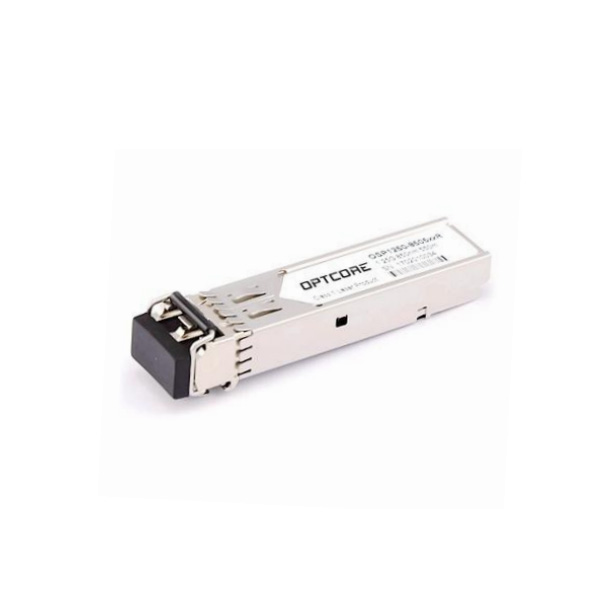


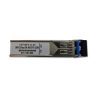
OSP1250-3120xxR | 1.25Gb/s SFP LX Optical Transceiver Module, Single Mode, 1310nm, 20km Reach
R270.00 ___Incl. VAT
Features
● Support Up to 1.25Gb/s data links
● Compliant with SFP MSA standard
● Compliant with IEEE 802.3z
● Hot pluggable SFP footprint
● 1310nm FP laser transmitter and PIN photo-detector
● Single 3.3V power supply
● Duplex LC connector
● Low power dissipation
● Metal enclosure provides lower EMI
● ROHS compliant and Lead Free
● Operating Temperature: Standard 0~70ºC Extended -10~85ºC Industrial -40~85ºC
● Optional Digital Diagnostic Monitor Interface
Applications
● 1G Fiber Channel, Switch to Switch Interface
● Gigabit Ethernet, Switched Backplane Applications
● Broadband aggregation and wireless infrastructure
● Router/Server Interface
● Other Optical networking
Description
Optcore OSP1250-3120xxR is high performance and cost-effective small form factor pluggable (SFP) transceiver
module for 1000BASE-LX/LH Gigabit Ethernet per IEEE802.3z and 1G Fiber Channel application. It supports dual
data-rate of 1.25Gbps/1.06Gbps and 20km transmission distance with 9/125um single mode fiber. This 1.25G SFP LX
transceiver module fully complies with the SFP Multi-Sourcing Agreement (MSA) and can be used on MSA compliant
SFP ports of optical networking equipment. The transmitter section uses a 1310nm FP laser that is a class 1 laser
product compliant according to International Safety Standard IEC 60825. The receiver section uses a high-speed PIN
photodiode integrated with a trans-impedance preamplifier (TIA).
There are three versions of the series 1.25Gb/s SFP LX optical transceiver modules for different applications. The
Standard grade (0~70ºC) is for commonly commercial application, the Extended grade (-10~85ºC) is for Extended
temperature application, and the Industrial grade (-40~85ºC) is made with robust and reliable components to meet the
needs of Industrial Ethernet application under harsh environmental conditions.
Absolute Maximum Ratings
| Parameter | Symbol | Min | Max | Unit | Notes |
| Maximum Supply Voltage | Vcc | -0.5 | 4.0 | V | |
| Storage Temperature |
TS |
-40 | 85 | °C | |
| Operating Humidity | RH | 5 | 95 | % |
Recommended Operating Conditions
| Parameter | Symbol | Min. | Typ. | Max. | Unit | Notes |
| Power Supply Voltage | Vcc | 3.13 | 3.3 | 3.47 | V | |
| Power Supply Current | Icc | 250 | mA | |||
|
Case Operating Temperature |
Tc |
0 | 70 | °C | Standard | |
| -10 | 85 | °C | Extended | |||
| -40 | 85 | °C | Industrial | |||
|
Data Rate |
1.25 | Gbps | Gigabit Ethernet | |||
| 1.06 | Gbps | Fiber Channel | ||||
| Transmission Distance | 20 | km | 9/125µm SMF |
Optical Characteristics
| Parameter | Symbol | Min. | Typ. | Max. | Unit | Notes |
| Transmitter | ||||||
| Center Wavelength | λC | 1270 | 1310 | 1360 | nm | |
| Average Output Power | P0ut | -9 | -3 | dBm | 1 | |
| Spectral Width (RMS) | σ | 4 | nm | |||
| Extinction Ratio | ER | 9 | dB | 1 | ||
| Optical Rise/Fall Time | Tr-Tf | 0.26 | ns | 2 | ||
| Total Jitter | 0.431 | UI | ||||
| Output Optical Eye | Compliant with IEEE802.3 z (class 1 laser safety) | |||||
| Receiver | ||||||
| Center Wavelength | λC | 1270 | – | 1610 | nm | |
| Receiver Sensitivity | -22 | dBm | 3 | |||
| Receiver Overload | -3 | dBm | 3 | |||
| LOS De-Assert | LOSD | -24 | dBm | |||
| LOS Assert | LOSA | -35 | dBm | |||
| LOS Hysteresis | 0.5 | 6 | dB | |||
- Measured at 1.25Gbps with PRBS 27– 1 NRZ test pattern.
- Unfiltered, measured with a PRBS 27-1 test pattern @1.25Gbps
- Measured at 1250 Mb/s with PRBS 27– 1 NRZ test pattern for BER < 1×10-12
Electrical Input/Output Characteristics
| Parameter | Symbol | Min. | Typ. | Max. | Unit | Notes | |
| Transmitter | |||||||
| Input differential impedance | ZIN | 100 | Ω | ||||
| Data Input Swing Differential | Vin,pp | 300 | 1600 | mV | |||
| TX Disable – High | VIH | 2.0 | Vcc+0.3 | V | |||
| TX Disable – Low | VIL | 0 | 0.8 | V | |||
| TX Fault – High | VOH | 2.0 | Vcc+0.3 | V | |||
| TX Fault – Low | VOL | 0 | 0.5 | V | |||
| Receiver | |||||||
| Data Output Swing Differential | Vout,pp | 400 | 1000 | mV | |||
| RX LOS – High | VLOS | 2.0 | Vcc+0.3 | V | |||
| RX LOS – Low | VLOS | 0 | 0.8 | V | |||
Pin Descriptions
| Pin | Signal Name | Description | Plug Seq. | Notes |
| 1 | VEET | Transmitter Ground | 1 |
| 2 | TX FAULT | Transmitter Fault Indication | 3 | Note 1 |
| 3 | TX DISABLE | Transmitter Disable | 3 | Note 2 |
| 4 | MOD_DEF(2) | SDA Serial Data Signal | 3 | Note 3 |
| 5 | MOD_DEF(1) | SCL Serial Clock Signal | 3 | Note 3 |
| 6 | MOD_DEF(0) | Model present indication | 3 | Note 3 |
| 7 | Rate Select | Not Connected | 3 | |
| 8 | LOS | Loss of Signal | 3 | Note 4 |
| 9 | VEER | Receiver ground | 1 | |
| 10 | VEER | Receiver ground | 1 | |
| 11 | VEER | Receiver ground | 1 | |
| 12 | RD- | Inverse Received Data Out | 3 | Note 5 |
| 13 | RD+ | Received Data Out | 3 | Note 5 |
| 14 | VEER | Receiver ground | 1 | |
| 15 | VCCR | Receiver Power Supply | 2 | |
| 16 | VCCT | Transmitter Power Supply | 2 | |
| 17 | VEET | Transmitter Ground | 1 | |
| 18 | TD+ | Transmit Data In | 3 | Note 6 |
| 19 | TD- | Inv. Transmit Data In | 3 | Note 6 |
| 20 | VEET | Transmitter Ground | 1 |
Notes:
- TX Fault is an open collector output, which should be pulled up with a 4.7k~10kΩ resistor on the host board to a voltage between 2.0V and Vcc+0.3V. Logic 0 indicates normal operation; Logic 1 indicates a laser fault of some kind. In the low state, the output will be pulled to less than 0.8V.
- TX Disable is an input that is used to shut down the transmitter optical output. It is pulled up within the module with a 4.7k~10kΩ resistor. Its states are:
Low (0 to 0.8V): Transmitter on (>0.8V, < 2.0V): Undefined
High (2.0 to 3.465V): Transmitter Disabled Open:Transmitter Disabled
- Mod-Def 0,1,2. These are the module definition pins. They should be pulled up with a 4.7k~10kΩ resistor on the host board. The pull-up voltage shall be VccT or VccR.
Mod-Def 0 is grounded by the module to indicate that the module is present
Mod-Def 1 is the clock line of two wire serial interface for serial ID Mod-Def 2 is the data line of two wire serial interface for serial ID
- LOS is an open collector output, which should be pulled up with a 4.7k~10kΩ resistor. Pull up voltage between
2.0V and Vcc+0.3V. Logic 1 indicates loss of signal; Logic 0 indicates normal operation. In the low state, the output will be pulled to less than 0.8V.
- RD-/+: These are the differential receiver outputs. They are internally AC-coupled 100 differential lines which should be terminated with 100Ω (differential) at the user SERDES.
- TD-/+: These are the differential transmitter inputs. They are internally AC-coupled, differential lines with 100Ω
differential termination inside the module.
Optcore 1.25Gb/s SFP LX optical transceiver support the 2-wire serial communication protocol as defined in the SFP MSA. It is very closely related to the E2PROM defined in the GBIC standard, with the same electrical specifications. The standard SFP serial ID provides access to identification information that describes the transceiver’s capabilities, standard interfaces, manufacturer, and other information.
Additionally, Optcore 1.25Gb/s SFP LX optical transceiver provide an optional enhanced digital diagnostic monitoring interface, which allows real-time access to device operating parameters such as transceiver temperature, laser bias current, transmitted optical power, received optical power and transceiver supply voltage.It also defines a sophisticated system of alarm and warning flags, which alerts end-users when particular operating parameters are outside of a factory set normal range.
The SFP MSA defines a 256-byte memory map in E2PROM that is accessible over a 2-wire serial interface at the 8 bit address 1010000X (A0h). The digital diagnostic monitoring interface makes use of the 8 bit address 1010001X (A2h), so the originally defined serial ID memory map remains unchanged. The interface is identical to, and is thus fully backward compatible with both the GBIC Specification and the SFP Multi Source Agreement.
The operating and diagnostics information is monitored and reported by a Digital Diagnostics Transceiver Controller (DDTC) inside the transceiver, which is accessed through a 2-wire serial interface. When the serial protocol is activated, the serial clock signal (SCL, Mod Def 1) is generated by the host. The positive edge clocks data into the SFP transceiver into those segments of the E2PROM that are not write-protected. The negative edge clocks data from the SFP transceiver module. The serial data signal (SDA, Mod Def 2) is bi-directional for serial data transfer. The host uses SDA in conjunction with SCL to mark the start and end of serial protocol activation. The memories are organized as a series of 8-bit data words that can be addressed individually or sequentially.
Digital diagnostics for this 1.25G SFP LX optical transceiver is internally calibrated by default.
Related products

10Gb
Optcore 10GBASE-T SFP+ Copper RJ45 Industrial Transceiver, Compatible with Brocade 10G-SFPP-T-I


1Gb
Optcore Replacement for Customized SFP-1G-T Compatible 1000BASE-T SFP RJ45 100m Copper Transceiver




2.5Gb


10Gb